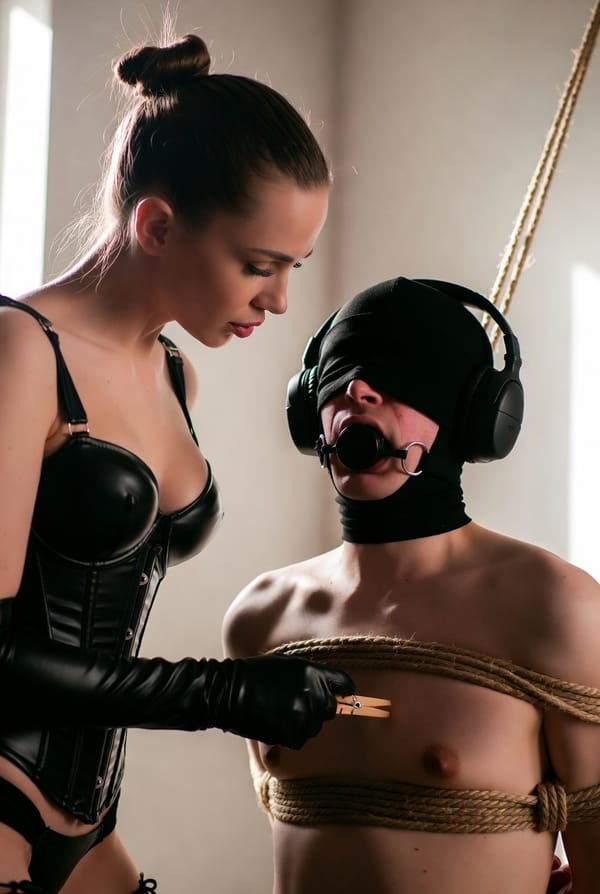
Punishment vs. Discipline in Femdom, Part 2: Discipline, The Structure That Never Sleeps


Part 1 separated the two machines: discipline, the structure that shapes him every day, and punishment, the consequence that falls when he fails it. This part goes inside the first machine: protocols, rituals, chastity schedules, written assignments, inspections, journals. The unrelenting architecture that maintains a power dynamic for years, and molds a slave not inscenes, but a day at a time.
The Machine Room
Ask a novice Mistress where a slave is made and she will point to the Dungeon: the cross, the cane, the dramatic hour. Ask a veteran and She will point to something much less photogenic. A Tuesday. An ordinary Tuesday, three months into a dynamic, when no scene is planned and no punishment is owed, and he still wakes before his alarm to prepare Her coffee exactly as protocol demands, still writes his journal entry in the prescribed form, still wears his lock through a day of meetings and errands, feeling its weight with every step. That is where he is made. Not in the hour of the cane. In the thousand repetitions nobody applauds.
Part 1 established the definitions: discipline is proactive and structural, the antecedent, everything arranged before behavior so that obedience is the path of least resistance. This part is the engineering manual for that machine. A structure is not a mood, and it is not a list of rules read aloud once and forgotten. A structure is a system that runs on days when She is tired, distracted, traveling, or simply not thinking about him at all, and it runs precisely because it was built to. Punishment is an event. Discipline is infrastructure. And infrastructure, patiently maintained, is what eventually stops being something done to a man and starts being the shape of the man himself.
The Science of the Ordinary: How Repetition Rewires a Man
The laboratory science here is less bloody than Part 1's conditioning research, and far more powerful. It is the science of habit, and habit, not willpower, is what a long-term dynamic is built from.
The Loop That Runs Him
Neurologists describe habit as a three-part loop: a cue, a routine, and a reward. A cue fires (the alarm, the sound of Her key in the door, the sight of his collar on the dresser) and the routine executes almost before conscious thought engages, drawn forward by the reward wired to its end. Run the loop enough times in the same context and the behavior migrates out of the effortful, deciding part of the brain into automaticity: the realm of reflex, where actions cost no willpower because they are no longer chosen. They are simply what happens next.
How long does that migration take? Longer than the myth, shorter than forever: studies of habit formation find new behaviors becoming automatic across a range of roughly three weeks to eight months, averaging around two months of consistent daily repetition. The crucial finding is that missing a day does not reset the process. Abandoning the context does. She has watched it happen. The protocol that required reminders in week one requires none in month two. By month six, he would feel wrong skipping it. The omission itself itches. That itch is the structure taking up residence in his nervous system. She is no longer supervising a behavior. She is watching a reflex She installed.
Why Ritual Is Not Decoration
Skeptics dismiss ritual as theater: the kneeling, the forms of address, the prescribed presentations. The science disagrees, and so does every serious practitioner of structured D/s. Ritual is a gear-shift for the brain. Human beings do not slide between mental states frictionlessly; we cross thresholds, and thresholds need markers. The greeting ritual at the door, the collaring ritual that opens a scene, the five minutes of kneeling reflection before he reports for the evening: each one is a liminal act, a deliberate crossing from the world where he is a man with a job and opinions into the world where he is Hers. Performed daily, the crossing gets shorter and deeper: the body learns the route, and his breathing slows at the ritual's first step the way it once slowed at the last. Ritual is how a dynamic survives contact with an ordinary life. And protocol has a second, colder virtue: it is measurable in a way devotion is not. She cannot inspect his feelings. She can inspect whether he knelt, whether the journal is written, whether the presentation was correct. Structure gives Her something to hold, and gives him the relief of knowing exactly where he stands, every day.
The Anatomy of a Protocol System: Three Kinds of Law
A working structure is not one undifferentiated pile of rules. Those who build dynamics that last sort their law into three distinct kinds, each doing a different job. Confuse them, and the system wobbles. Separate them, and it runs for years.
Rituals and Protocols: How He Is Hers
Protocols govern form: how he greets Her, how he addresses Her, how he presents himself, where he may sit, when he may speak and in what register. Speech protocols (the required honorific, the prescribed forms of assent) look like etiquette and function like identity equipment: a man who must shape every sentence around Her title rehearses his place with every breath. Position protocols (kneeling to present, furniture by permission only, sleeping where he is put) do the same work through the body. None of these rules accomplish a task. That is not their purpose. Their purpose is that he cannot move through an hour of his day without the dynamic touching him. Protocols are the walls of the cage: always there, always felt, defining the space he lives in.
Standing Orders: What He Does for Her
Standing orders govern function: the recurring tasks and duties that constitute his service. Some run on a schedule: Her coffee prepared to specification, the daily to-do list kept short enough to fit the card She approves, the five minutes of reflection followed by the text message confirming it was done. Some are situational: no orgasm without permission, the fuel tank never below half, Her boots cleaned before they are needed. Standing orders are where discipline becomes useful, and their usefulness is not a compromise of the erotic. It is the erotic's proof. A slave whose structure genuinely improves Her daily life is not playing at service between scenes. He is load-bearing.
Behavioral Assignments: What He Is Becoming
The third kind of law aims past the day entirely. Behavioral assignments are the structure's training arm: the journal he keeps in the form She sets, the posture and deportment drills, the reading She assigns and examines him on, the written reflections he submits for Her judgment. Assignments differ from standing orders in one essential way: they have a direction. A standing order maintains. An assignment develops. It exists because there is a gap between the slave he is and the slave She is building, and the assignment is the bridge, crossed daily, in writing, under inspection. This is the layer where Domina Planet's own model lives: the long-term training series, in which a slave's education proceeds in stages across weeks and months, each stage's assignments verified before the next begins. It is slow, it is deliberate, and compounded over a year it produces the transformations outsiders call impossible.
The Day, Structured: Five Instruments
Theory is cheap. Here is the machinery as it actually runs: five instruments, each simple, together constituting a day that belongs to Her from the first hour to the last.

The Morning Lock-In
The day is won or lost before breakfast. A morning protocol (rising at the set hour, the prescribed presentation or message of devotion, the first service task completed before his own needs are touched) does more than start his day correctly. It establishes the order of his world before the world can argue. The man who has already knelt, already served, already reported, walks into his job carrying the structure inside him. The form varies: a full presentation ritual for couples who live together, a timed text and photograph for slaves serving at a distance. But the fixedness does not. Same hour. Same form. Every day. The morning lock-in is the cue that starts every loop he runs.
The Inspection
Periodically, weekly is the classic rhythm, the structure stops running on trust and submits to verification. He presents himself; She examines: his body and grooming against the standard, his lock and its condition, the state of his assigned duties. The inspection is discipline's audit, and its power is not in what it catches. Its power is that it exists. A slave who knows Friday brings inspection keeps Thursday's standard without being told. Anticipated scrutiny is scrutiny that works seven days a week, and the inspection is also one of the most intimate acts in the dynamic: her hands and eyes on him, unhurried, total, his stillness under Her examination a form of worship no scene can counterfeit.
The Journal and the Ledger
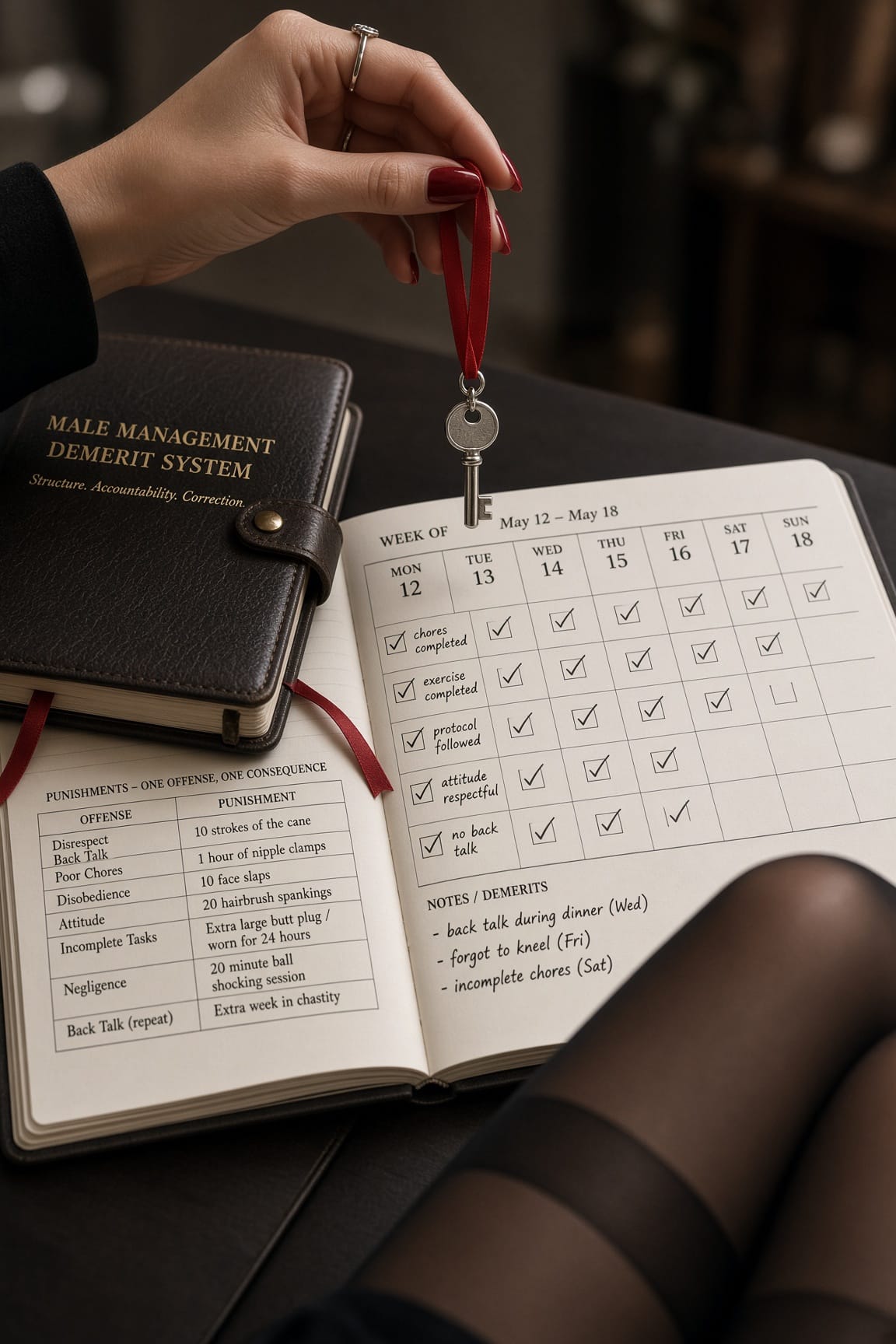
What is not recorded cannot be governed. The disciplined slave keeps a journal in the form She prescribes: the day's obediences and failures, his assignments' progress, his state of body and mind, what he is struggling to surrender. She reads it on Her schedule. The journal is also, quietly, the most honest mirror a slave ever faces. A man can lie to his Domme's face for a week. He cannot keep a daily written record for six months without the truth about himself surfacing on the page, and many Dommes find the journal entry, not the caught infraction, is where a slave's real training happens. He reads what he wrote. He sees what he is. He brings it to Her himself.
The Chastity Calendar
Of all discipline's instruments, chastity is the one that never clocks out, and in a structured dynamic it is run not as a game but as a schedule, administered with the same seriousness as everything else in this part. The calendar governs: the lock-up date and the terms of the term; the scheduled releases (for hygiene, for inspection, for Her use of him), each one an appointment he anticipates for days; the denial intervals that lengthen as his training deepens; and the state of his orgasm, which under a real chastity regime is not a private function but an administered privilege, granted, withheld, ruined, or milked strictly by Her policy. Understand what the calendar does to a man. His arousal stops being weather (random, private, his) and becomes currency in an economy She controls. Every day locked, his body rehearses the central fact of the dynamic: what I want is not the point; what She decides is the point. Weeks of that rehearsal re-route his desire itself toward service, toward Her approval, toward the only release valve the economy offers: being pleasing. Part 4 follows the calendar to its endpoint, permanent chastity. Here it is enough to say the schedule works because it is boring in its reliability. She never forgets a date on it. Neither, soon, can he.
The Evening Accounting
The day closes as it opened: in form. A brief evening protocol (the report rendered, the journal written, the failures of the day confessed while they are small) keeps the ledger short and the structure honest. The logic is the one that governs the whole machine: nothing festers, nothing accumulates in the dark, everything is named and settled on schedule. A day inside the structure is a circle. A year of them is a spiral, descending or ascending into what he is becoming.
From the Inside: Month Six
Month six feels different from the start, and deeper, and no one warns him about it.
By month six the protocols have stopped feeling like rules he follows and started feeling like facts he inhabits. He does not decide to use Her title; the sentence simply comes out that way, and hearing himself use a lesser form (once, in company, by accident) produces a small internal lurch, as if he had stepped on a stair that was not there. The lock, which began as an erotic device, has become closer to a wedding ring worn inward: its absence, on a scheduled release day, feels stranger than its presence ever did. The structure has crossed the border Part 1 promised: from Her hands into his spine.
And there is a shadow side no honest account skips. Month six is also when the novelty is gone and the structure must survive boredom, stress, illness, bad weeks, his and Hers. The dynamic that only runs when everyone feels inspired is not a structure; it is a hobby. The veteran's secret is unglamorous: the protocols are kept at seventy percent on the worst week rather than abandoned at zero, the schedule bends under real life and resumes. The machine's true strength was never its intensity. It is its refusal to stop. That refusal, compounded, is what a slave means, years later, when he says the discipline did not just change his habits. It changed what the word "I" refers to.
Protocols: Building the Structure in Depth
Part 1 laid the foundation: three protocols, a consequence ladder, the Naming Rule. Here the same three levels return, rebuilt as what they were always meant to become: the calendar of a governed life.
Level One: The Skeleton Week
- Anchor the day at both ends. Install the morning lock-in and the evening accounting first, before any other protocol. Everything else can be hung on that frame later.
- Add one standing order, chosen for usefulness. His first duty should make Her life measurably better: the coffee, the list, the task She actually needs done. Service genuinely used is service genuinely kept.
- Start the journal on day one, in a fixed form. Three entries minimum: the day's obediences, the day's failures, one thing he is working to surrender. Short is fine. Daily is not negotiable.
- Trial every new rule, and keep the count low. No protocol enters the structure permanently on its first day: run it for a set trial, a week is the classic unit, with a scheduled review at the end. And hold the skeleton week to perhaps six active requirements. The novice's instinct is thirty. Six kept perfectly will build him faster than thirty kept at half. Only kept rules generate the automaticity the whole system depends on.
Level Two: The Full Architecture
- Give the week a rhythm, not just the day. Assign the days their characters: an inspection day, a maintenance day (Part 1's oath re-sworn), a day of heavier assignment work, a day of rest in reduced protocol. Anticipation, as ever, does half the work for free.
- Begin the chastity calendar. Start with short, fixed terms, days, not weeks, with scheduled releases for hygiene and inspection, and lengthen the terms only as his keeping of them proves out. The calendar is written down, dated, and kept by Her; what it says is what happens, and its authority comes from never being improvised.
- Layer in the behavioral assignments. Deportment drills, assigned reading with examination, written reflections reviewed at the weekly accounting. Each assignment carries a completion standard and a verification method: how She will know it was done, and done properly. An assignment She cannot verify is a wish, not a law.
- Schedule the structure's own review. Monthly, sit down, out of role if necessary, and audit the system itself. Which rules are producing growth? Which have become empty ritual? Which are generating failures that signal bad construction rather than bad slaves? Retire dead rules without ceremony.
- Protect the reinforcement economy. As the architecture grows, Her recognition must be scheduled with the same care as Her scrutiny. The inspection that finds everything correct should say so, at length, in detail. Part 1's science holds at every level: reinforcement, delivered inside the structure, does the deep rewiring. The structure is the delivery system. Her approval is the payload.
Level Three: The Permanent Structure
- Extend protocol into the vanilla world, invisibly. At this depth the structure develops its public forms: the form of address that passes in company, the small services no observer reads as anything but courtesy, the standing orders that run inside a business trip on another continent. He is never off; he is simply operating the structure's discreet frequencies. The cage now travels with him, because the cage is no longer a place. It is a practice.
- Lengthen the cycles. Chastity terms measured in months, assignment programs in stages, reviews in quarters. The permanent structure thinks in seasons, not scenes, and plans his development on a horizon of years.
- Let the structure hold bad times without Her hand on it. The final test of Level Three is a month where She is absent, ill, or consumed by Her own life, and the protocols run anyway, the journal fills, the calendar holds, because he now maintains the structure as his own act of devotion. That is not the dynamic weakening. That is the dynamic completed: the point at which discipline has fully become what Part 1 called it, the weather of his world, in every season, whether or not She is standing in it.
Safety and Ethics: Governing the Machine
Structure looks safer than punishment: no implements, no intensity, and in the ways that draw blood, it is. But a machine that runs on a man's whole life carries its own voltage, and the veterans who run one for decades respect a different set of ground rules.
Rule overload is the classic structural failure. Every protocol costs attention, and attention is finite, his and Hers. A structure that demands more monitoring than She can actually perform teaches the worst lesson in the vocabulary: that rules are announced and not enforced, which corrodes obedience faster than no rules at all. Build only what She will genuinely inspect, and grow the system at the speed of Her real capacity to govern it, not at the speed of fantasy.
Every rule needs a suspension clause. Illness, injury, family crisis, the week his job hangs by a thread: a structure with no humane off-ramps does not produce devotion under pressure; it produces concealed failure, quiet resentment, and eventually a slave who disappears rather than confesses he could not keep it all. The mature structure builds the off-ramps in advance: how a rule is paused, by whom, and how it resumes. Pausing a rule by the system's own procedure is the system working. The alternative is a slave deciding alone, in the dark, which laws still apply to him.
Guard the written record. The journal is among the most intimate artifacts a human being can produce: a daily, uncensored account of his failures, desires, and surrenders. Its security and privacy are not administrative details; they are ethical obligations. Who may read it, where it lives, what happens to it if the dynamic ends: settle these before the first entry, and honor them absolutely. A Domme who is careless with her slave's exposure has failed at the first duty of ownership: protection.
Chastity has a body, and the body has rules. The calendar never outranks physiology. A device must fit without constricting circulation. Persistent numbness, coldness, discoloration, or swelling are stop signals, not milestones. Skin under a device needs scheduled release, washing, drying, and inspection; broken skin ends the term, full stop. Terms lengthen gradually, across months, never by sudden decree, and a slave new to long wear is checked more often, not less. The goal is a man governed for years, not a record set once and an injury to show for it.
Never let the structure eat the relationship. This is the deepest rail, and the one experienced Dominants name most often. A protocol system can become so complete that the two people inside it stop meeting each other: every interaction a form, every hour administered. The structure exists to serve the dynamic, and the dynamic exists because two people chose each other. Keep unstructured time inside the structure: time that is deliberately ungoverned, where she is not an administrator and he is not a report. It is that ungoverned warmth that the governed hours draw their meaning from. A cage with nothing alive inside it is just furniture.
And beneath all of it, Part 1's foundation still holds: consent and the safeword govern the structure exactly as they govern the scene. A slave may veto a rule at negotiation, may call for renegotiation when a rule is breaking him rather than building him, and may end the dynamic. That sovereignty is what makes everything inside it surrender rather than captivity. The structure is mighty because he chose it. Keep it chosen.
The Structure Stands
Know this, and you hold the slower, stronger of the two levers. Build the structure: the rituals that mark his thresholds, the standing orders that make him load-bearing, the assignments that close the gap between the slave he is and the slave You are making. Keep the rhythm: the five instruments turning like gears whether You are watching or not, because a machine that only runs under supervision is not a machine at all. Become the weather, until the protocols are no longer things he obeys but the climate he lives in, and his obedience is no longer a performance renewed daily but a reflex, a habit, a home.
But a structure this complete casts a shadow, and You already know its name. What happens on the day he fails it, truly, deliberately, at the standard the structure set? In Part 3, we take up the second machine in full: Punishment: the named infraction, the counted consequence, and the craft of making a lesson his body never forgets.
To see these principles in action, explore Domina Planet's discipline and training scenes:
- Real Slave Training: Mistress Mona Thea - Making You My Bitch: Mistress Mona Thea runs a full training session. Not a scene, a curriculum, where instruction, correction, and repetition do the slow work of making a slave.
- Furniture Face: Mistress Nova turns position protocol into flesh: a slave whose function is furniture, holding his place and his purpose under Her use.
- Real Slave Training: Queen Daisy - Serve My Pussy: Queen Daisy puts service itself on the schedule: a standing order performed on demand, exactly to standard, because that is what standing orders are for.